
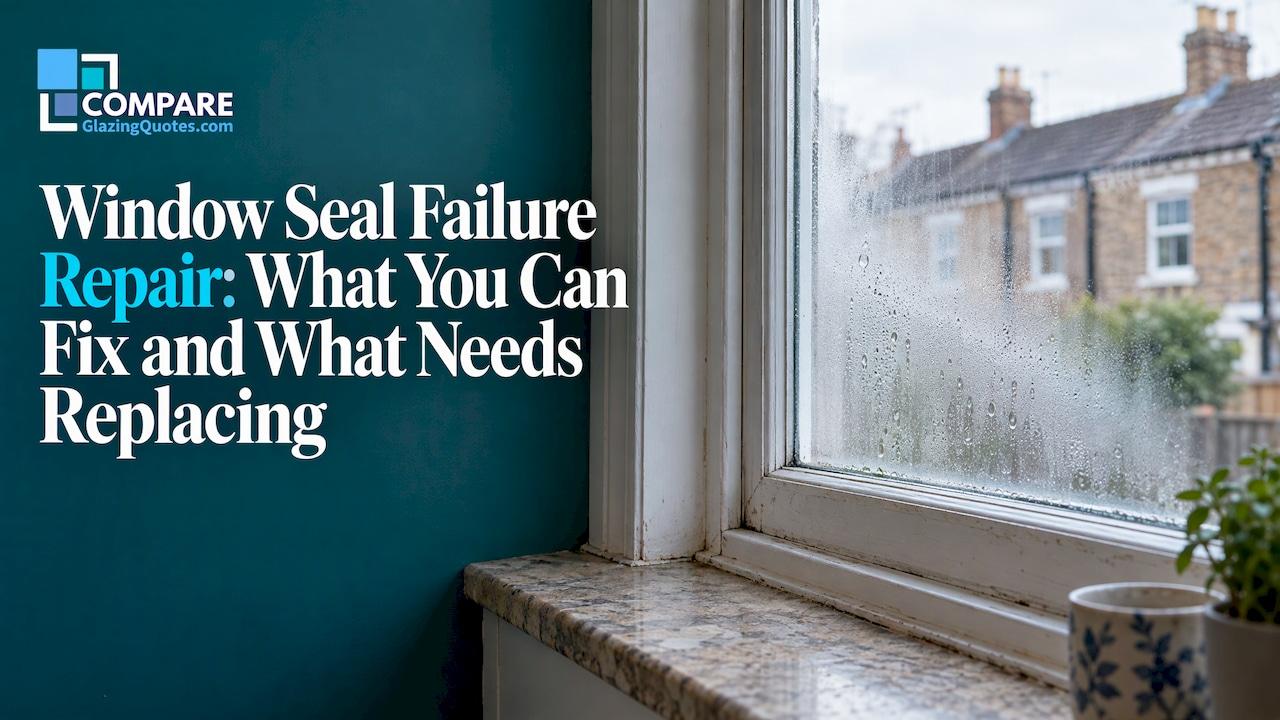
A failed window seal is one of three different problems, and the fix depends on which one you have. A worn rubber gasket can be replaced in minutes. A cracked external silicone bead can be cut out and redone. Misting between the panes means the sealed glass unit itself has failed, and that unit has to be replaced rather than resealed. This guide shows you how to tell them apart, what is safe to do yourself, what a professional will charge, and when it makes more sense to price up new windows.
TL;DR
- Hard, shrunken or split rubber is a gasket problem. Damp on the plaster around a dry frame points to the external silicone. Haze or droplets between the panes mean the sealed unit has failed.
- Gaskets and silicone are sensible DIY jobs. A failed sealed unit is not: the glass unit is replaced, not patched.
- Expect roughly £40 to £65 per window for professional gasket replacement, and a few hundred pounds for a mid-sized replacement sealed unit.
- If several windows are misting, draughty or old, compare quotes for new windows before you pay for repair after repair.
- Only use installers registered with FENSA or CERTASS for glazing work, so the work is certified.
Table of Contents
- Which seal has actually failed?
- Replacing a worn rubber gasket
- Fixing failed external sealant
- Can a misted double-glazed unit be repaired?
- Is it worth resealing windows?
- What affects the price of a window seal repair?
- Choosing an installer for repairs and replacements
- Our view on repair versus replacement
- Get matched with local installers
- When to call a professional straight away
- FAQ
- Sources
Which seal has actually failed?
Before you buy anything, work out which of the three seals is the culprit. A window has more than one, and they fail in different ways. GB DIY's guide to window sealant versus window seal separates them in a useful way, and the table below follows the same logic.
| What you see | Likely failure | Fix |
|---|---|---|
| Rubber gasket hard, shrunken, cracked or pulling out of its groove; draught or whistling at the closed sash | Rubber gasket | Replace the gasket |
| Damp or staining on the inside wall or plaster around the frame, while the window itself is dry | External silicone bead between frame and brickwork | Cut out and reapply the sealant |
| Haze, condensation or droplets between the panes that you cannot wipe off | Sealed double-glazed unit | Replace the sealed unit |
A few quick checks help you decide.
The draught test. On a windy day, hold the back of your hand or a lit tealight (carefully, away from curtains) along the closed sash. Moving air or a flickering flame along the edge points to the gasket or to a sash that no longer closes tightly.
The wipe test. Condensation on the inside of the room-facing glass, or on the outside in cold weather, wipes off. Moisture between the panes does not. If you can wipe the mark away, the sealed unit is probably fine.
The dry-frame test. If the plaster beside the frame is damp but the glass and frame are dry, water is likely getting in around the outside of the frame. That is a sealant or flashing job, not a glass job.
What usually causes seals to fail
Rubber perishes with age, sunlight and temperature swings, so gaskets harden and shrink away from the corners. External silicone cracks and lifts as the frame and masonry move slightly through the seasons. Sealed units fail when the perimeter seal around the two panes breaks down, letting moist air in. Once that has happened, the moisture arrives faster than any desiccant inside the spacer can cope with. All three are normal ageing, and none of them is a sign that you have done anything wrong.

Replacing a worn rubber gasket
This is the most common repair behind a draughty uPVC window, and it is a reasonable job for a confident DIYer. You are only swapping a rubber strip that presses into a groove.
- Identify the profile. Pull a short piece of the old gasket free and take it, or a clear photo with a coin for scale, to a glazing supplier or builders' merchant. Gaskets come in several profiles and the wrong one will not seat.
- Pull out the old gasket. Start at a corner and peel it from the groove along the whole sash. Keep it so you can measure the length.
- Clean the groove. Wipe out dirt and old residue with a damp cloth and a little mild detergent, then dry it.
- Press in the new gasket. Push it in by hand, starting at a corner or the middle of the top edge. Do not stretch it as you go, or it will shrink back later and open a gap at the corners. Leave a few millimetres spare at each corner.
- Cut and finish the corners. Trim to length with sharp scissors or a craft knife and make sure the ends meet neatly.
- Close the window and check. It should close with light resistance and no visible gaps. If it now closes too stiffly, the hinges or keeps may need adjusting.
For materials, Future Glass and Windows puts DIY gasket at about £10 to £15 per window, against £40 to £65 per window if a tradesperson fits it. Some tradespeople price by length instead, so ask which basis a quote uses. Be aware that many firms also set a minimum call-out charge: one Hampshire installer lists gasket work from £40 per window but a £180 minimum visit, which means a single window on its own costs more per window than several done together.
Fixing failed external sealant
If the damp is on the wall rather than the glass, the silicone bead between the frame and the brickwork has probably cracked, shrunk or lifted. Do not simply squeeze a new bead over the top of the old one. It will not bond to dirty, cracked silicone and will fail again within a season or two.
- Cut out all the old sealant with a sharp blade or a sealant-removal tool.
- Clean and dry the joint. Remove dust, algae and grease. Let it dry fully on a dry day.
- Mask both sides with painter's tape for a neat line.
- Apply a sealant suitable for exterior frames. Use a neutral-cure or frame sealant recommended for uPVC or the frame material you have. Fill the joint evenly in one pass.
- Tool the bead with a wet finger or a profiling tool, then remove the tape before it skins over.
- Leave it to cure before the next rain. Check the pack for cure times.
If the window sill itself leaks when it rains, check that the cill is sealed to the frame, that drainage slots at the bottom of the frame are not blocked with paint or dirt, and that there is no gap under the cill. If water still gets in after resealing, the cause may be a failed damp-proof detail or a defective cill, which is a job for a glazing or building professional.
Can a misted double-glazed unit be repaired?
This is the question behind many searches for a broken window seal. When you see moisture trapped between the panes, the airtight seal around the glass unit has failed. You cannot properly reseal the edge of a unit from the outside, because the moisture is already inside the cavity and the factory-made seal cannot be remade on site.
Some companies offer drill-and-dry or defogging treatments that clear the glass cosmetically. Even where these are offered, they do not restore the original sealed, gas-filled unit, so the insulation benefit is not what it was. The reliable fix is to replace the sealed unit and keep the existing frame.

That is the good news: if the frame is sound, you only pay for new glass. Costs published for 2026 put a replacement sealed unit at £80 to £180 for a small window, £250 to £360 for a mid-sized one and £380 to £600 for a large one, plus about £50 to £60 labour per unit. Prices vary with glass specification, such as toughened or safety glass, and with whether the unit has a special finish.
Repair, replace the unit, or replace the window?
| Situation | Sensible option |
|---|---|
| One or two misted units, frame solid, hinges and handles working | Replace the sealed units |
| Gasket hard but frame and glass fine | Replace the gasket |
| Many units misting, frame warped, rotten or hard to close | Price up replacement windows |
| Failing seals plus draughts, drips and rising heating bills across the house | Price up replacement windows |
| Conservatory roof or side panels misting | Look at the conservatory glazing options |
A useful rule of thumb: if you are paying for the third repair on the same set of windows, step back and get a full quote. A new window comes with a fresh guarantee on the whole unit, which a patched older window cannot offer. Conservatory owners face this decision often, and our guide to conservatory window replacement walks through the signs and options.
Is it worth resealing windows?
It depends on which part you are resealing.
- Gasket replacement: usually well worth it. It is cheap, quick and often cures the draught completely.
- External silicone: worth doing as soon as you see cracking, because water behind the frame leads to damp, stained plaster and, over time, rot in surrounding timber.
- Misted sealed units: resealing is not the answer. Replacing the unit is.
Resealing cannot cure a problem that sits elsewhere. A sash that has dropped on its hinges, a handle that no longer pulls the window tight, or a frame that has moved will let air through whatever you do to the seals. If the new gasket still leaves a gap, have the hinges and locking points adjusted before you blame the rubber.
What affects the price of a window seal repair?
Quotes for repair work vary more than people expect, and the same job can come in at very different totals. The main drivers are:
- How many windows are done in one visit. Minimum call-out charges make a single small job expensive per window.
- Size and type of glass. Large, toughened or specialist units cost more.
- Access. First-floor windows, bay windows and conservatories take longer.
- Where you live. Labour rates differ across the UK.
- Whether the frame is sound. If the frame is damaged, a repair quote can quickly drift towards replacement cost.
Get at least two or three quotes for anything beyond a gasket. If you are weighing repair against replacement, our guide to how to get and compare window installation quotes explains what a good quote should itemise.
Choosing an installer for repairs and replacements
For sealed-unit replacement and new windows, choose a company registered with FENSA or CERTASS. These are the competent person schemes under which installers can self-certify that glazing work meets the building regulations, and they are the reason a certificate arrives after the job. Ask any installer for their registration number and a written, itemised quote that states the glass specification, the guarantee and the payment terms.
If you live in a flat, extra rules can apply to who owns the windows and who must consent to changes. We cover this in our guide to replacement windows for flats.
Our view on repair versus replacement
We speak to homeowners every day who started out looking for a quick seal repair and ended up with a bigger question: is it worth putting more money into old windows?
Our honest answer is that it depends on the evidence in front of you. A hard gasket or a cracked bead is a small job and a good installer will fix it quickly. A misted unit calls for a new sealed unit. When the problems are stacking up, the best decision is made with real numbers in hand, not guesses.
That is why we built a free, no-obligation comparison service. You tell us what you need, we match you with vetted local installers certified with FENSA and/or CERTASS, and you compare their quotes side by side. You see what the market charges before committing, and we believe that is how homeowners can save up to £2,000 on an installation.
No chasing five different firms, no pressure, and no charge to you.
James
Get matched with local installers
If your seals point to bigger work, such as several misted units, tired frames or a conservatory that has had its day, our free window, door and conservatory comparison service takes three steps: tell us what you need, get matched with vetted local installers, and compare their quotes. It costs you nothing and there is no obligation to go ahead.

We only include installers certified with FENSA and/or CERTASS. If you want to see how the service works in your area, browse our local coverage pages.
When to call a professional straight away
Some situations should not wait for a weekend DIY job:
- Water running down the inside wall or pooling on the sill after rain, which can damage plaster, floors and electrics nearby.
- A cracked or broken pane, or a unit you cannot safely handle. Glass is heavy and sharp, and large units should not be lifted alone.
- Windows that will not close or lock, which is a security issue as well as a seal issue.
- Persistent black mould around frames that returns after cleaning, which suggests a moisture source that needs tracing.
For mould that affects health, particularly for anyone with asthma or a respiratory condition, speak to your GP as well as dealing with the cause.
FAQ
How do I fix a broken window seal?
First identify the seal. A hard or shrunken rubber gasket is replaced with a matching profile, pressed into the groove. Cracked external silicone is cut out, the joint cleaned and dried, and fresh sealant applied. Misting between the panes needs a replacement sealed unit.
Can a failed double-glazed seal be repaired?
Not properly. The factory seal around the two panes cannot be remade on site, so the sealed unit is normally replaced while the frame stays. Some firms offer defogging treatments, but these do not restore the original unit. Replacing the unit is the dependable fix.
How much does it cost to replace window seals?
For a standard window, roughly £40 to £65 per window fitted, or around £10 to £15 in DIY gasket materials. Minimum call-out charges can raise the cost of a single window. A replacement sealed unit is a larger cost, from £80 to £600 plus labour depending on size.
Why does my window sill leak when it rains?
Common causes are cracked external sealant, blocked drainage slots in the frame and a gap beneath the cill. Clear the slots, reseal the joint and check the cill. If the leak continues, ask a glazing professional to inspect the frame and the surrounding wall.
Sources
- GB DIY: Window Sealant or Window Seal? What's Gone Wrong
- Future Glass and Windows: How Much Does It Cost to Replace a Window Seal in the UK?
- Restoration Glazing: Window Seal Replacement Cost
- Cost of Replacing Misted Double Glazing Units