
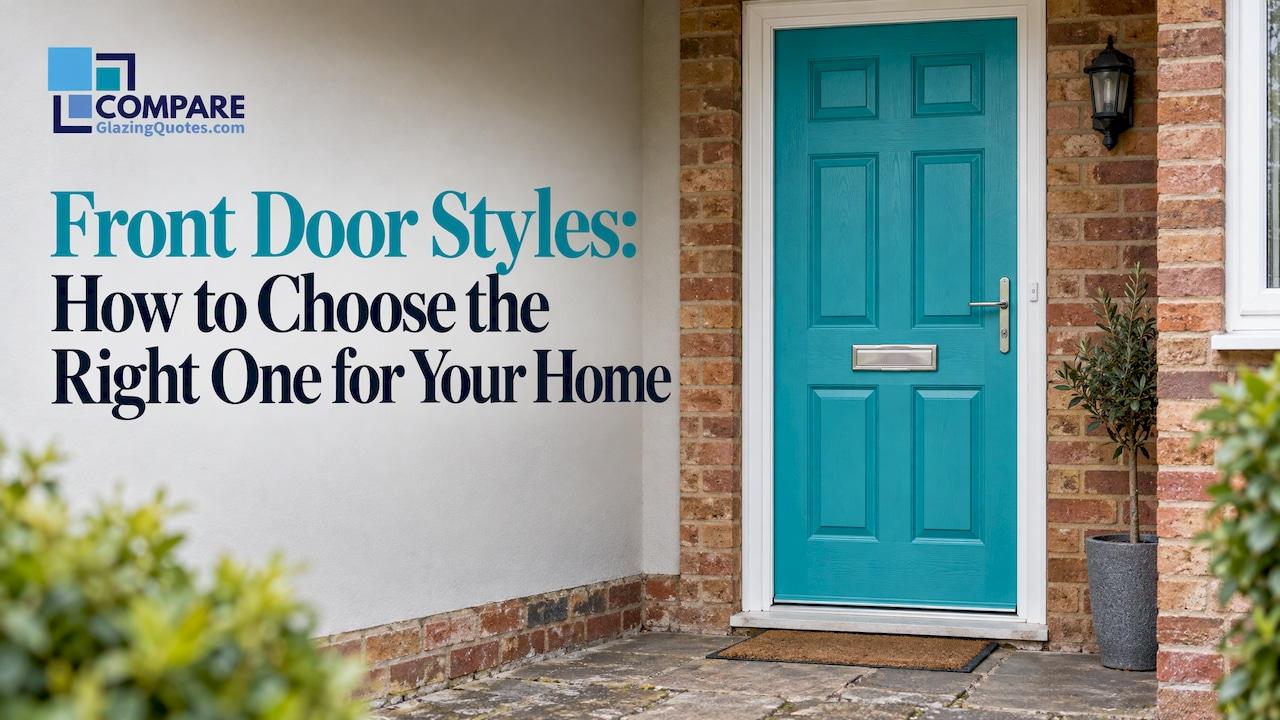
The best front door style is the one that suits your home's age and proportions, then meets your needs on security, upkeep and budget. Panelled doors suit period houses. Flush or slim-glazed doors suit modern homes and extensions. Cottage-style planked doors suit older, smaller properties. This guide walks through each style, matches it to the kind of house it flatters, and covers the practical points that settle the final choice.
TL;DR
- The main styles are panel, flush, glazed, cottage (planked or ledge-and-brace) and stable. Panel is the most common in the UK.
- Match the style to the age of the house: panelled with decorative glazing for pre-1940s homes, flat and minimally panelled for homes built from the 1990s onwards.
- Material shapes the look as much as the design. Timber, composite, uPVC and aluminium all give different finishes and maintenance demands.
- Check security (PAS 24, Secured by Design) and, for flats, fire rating before you fall for a design.
- Get several quotes for the same specification so you can compare like with like.
Table of Contents
- The main front door styles at a glance
- Matching the style to your home's age
- Choosing the material
- Colour and hardware: what is popular in 2026
- Security and safety: check these before the design
- A simple process for choosing
- Compare front door quotes from local installers
- Our perspective on choosing a front door
- Frequently asked questions
- Sources
The main front door styles at a glance
Most front doors fall into a handful of families. Names vary between manufacturers, but the underlying designs are consistent.
| Style | What it looks like | Best suited to |
|---|---|---|
| Panel | Moulded or raised panels, typically two, four or six, often with a small glazed section | Victorian, Edwardian, Georgian and 1930s homes; can also work on newer houses |
| Flush | Plain, flat face with no visible panels | Modern homes, extensions, contemporary renovations |
| Glazed | Large or partial glass area, from a single slim strip to a full-height pane | Dark hallways, homes wanting more daylight |
| Cottage (planked, ledge-and-brace) | Vertical planks, visible ledges, small windows, traditional ironmongery | Cottages, rural properties, older terraces |
| Stable | Split horizontally so the top opens independently | Country homes, kitchens opening to a garden |
There is also a growing group of hybrids: a flat-faced door with slim vertical glazing, or a traditional panelled door with a contemporary colour and long handle. Many people are mixing styles rather than sticking to one strict category.
Panel doors
The panel door is the classic. Panels come in two, three, four, six and eight-panel layouts, and the arrangement changes the character of the door. Six panels read as Georgian. Four panels with a glazed top pair read as Victorian. Because the design is so familiar, a panel door suits most British streets, and with a modern colour and handle it can look surprisingly contemporary.
Flush doors
A flush door has a plain surface with no raised detail. It is the simplest style to read and the easiest to pair with a modern facade. The Door Industry Journal's autumn 2026 article on modern door demand describes current modern designs as clean-lined, flush-finished, with symmetrical panels and slim geometric glazing, often paired with long-bar handles.
Glazed doors
Glazing is what turns a solid door into a light source for the hall. It can be a narrow vertical strip, a pair of small panes at the top, or a larger section with obscured glass. The same article makes a useful point: demand for modern doors is not simply for more glass. Homeowners are pairing slim geometric glazing with privacy and clean lines. Frosted, reeded or textured glass lets daylight in without a view of the hallway from the pavement.
Cottage and planked doors
Cottage doors often use timber or a convincing woodgrain finish, with planked or ledge-and-brace detailing, small glazed panes and traditional ironmongery such as a thumb latch or ring handle. They suit smaller, older or rural homes where a heavy, formal panelled door would feel out of scale.

Stable doors
A stable door splits across the middle so the top half can be opened alone. It is more common as a back or garden door than at the front, but some country properties use one at the main entrance.
Matching the style to your home's age
The quickest way to narrow the options is to look at when your house was built.
Period homes built before about 1940
Houses from before roughly 1940 generally suit panelled doors, decorative or leaded glazing and heritage colours. Within that:
- Georgian: symmetrical, formal, often six panels and a restrained colour.
- Victorian: four panels with glazing at the top, sometimes with a stained-glass or etched pattern, often with a letterbox set at mid-height.
- Edwardian: lighter and more glazed than Victorian, and often with side panels and a fanlight above the door.
The rule of thumb is to match the door to the home's proportions and panel arrangement. If your existing frame has a fanlight or sidelights, the new door should respect that opening instead of fighting it.
Homes built from the 1990s onwards
Modern homes usually suit flat or minimally panelled doors with simple glazing and contemporary finishes. Extensions and new-builds tend to look best with a flat face, no visible panels and a long handle. A heavily ornamented door on a plain brick box can look like a costume.
In between
Inter-war semis, 1960s and 1970s houses and similar sit in the middle. Here you have freedom. A simple panel door with modest glazing often works, and so does a flush door with a restrained colour. Look at the windows: the door should feel as if it belongs to the same family as the frames either side of it.
Listed buildings and conservation areas
If your property is listed, or sits in a conservation area, check with your local planning authority before changing the door. Historic England's advice is that historic doors should be kept wherever possible: repair is preferred, with a made-to-match replacement a last resort. In these cases, the style is largely decided for you by what was there before.
Choosing the material
Style and material go together, because some finishes only look right in certain materials. These are the four you will meet.
- Timber: authentic, especially on period properties, and can be repainted in any colour. It needs regular recoating or restaining to resist moisture and weathering.
- Composite: typically a tough GRP or ABS skin over an insulating core. It offers woodgrain or painted looks, good thermal performance and little maintenance. It suits both traditional and modern designs.
- uPVC: generally the most cost-effective and low-maintenance choice. It is widely available in panel and glazed styles, though it can look less premium than timber or composite.
- Aluminium: slim profiles and strong structure, which suit contemporary architecture and large glazed panels. Thermal breaks in the frame reduce heat transfer.
A useful way to think about it: timber is chosen for authenticity, composite for low maintenance with a convincing finish, uPVC for value, and aluminium for a sharp modern line.
Colour and hardware: what is popular in 2026
Colour and hardware change how a door reads more than most people expect. A six-panel door in sage green and one in anthracite grey are almost different products.
Trade coverage in Glass Times on the door trends shaping 2026 reports that anthracite remains one of the most popular colours from one major door manufacturer, while Pearl Grey, Sage and Chartwell Green are gaining interest. It also notes that traditional designs are performing strongly and that coordinated hardware, including brass and antique brass, is part of the conversation.
In practice, that points to a few directions:
- Warmer, softer colours: sage, cream, claystone and muted greens, rather than only black and grey.
- Brass-toned hardware: a move away from chrome and black towards satin or antique brass.
- Coordination: matching the door's finish and handles to the interior, windows and house number or lighting, so the entrance feels designed as a whole.
- Bespoke combinations: choosing colour, glazing and hardware separately, not accepting a fixed catalogue pairing.
Trends are a guide, not a rule. A door is a ten to twenty-year decision in most homes, so pick a colour you will still like once fashion has moved on. Heritage greens, deep blues, cream and natural wood tones have a long track record on British streets, and traditional cottage colours such as sage or forest green, duck egg blue and deep red all suit older homes.
Checking the whole frontage
Your door sits in a bigger picture: the path, the porch, the step, the driveway and the planting. If you are redesigning the approach as well, this guide to driveway entrance design is worth reading alongside your door choice, because the surface, layout and edge details should complement the door you end up with.
Security and safety: check these before the design
A door that looks right but fails on security is a poor buy. Two checks matter most.
PAS 24 and Secured by Design
In the UK, enhanced security for external doorsets is measured against standards such as PAS 24:2022+A1:2024, which tests resistance to opportunistic burglary. Many high-security products also carry Secured by Design (SBD) police accreditation, as set out in the Secured by Design Homes Guide.
Two details are worth knowing. PAS 24 tests the whole doorset, meaning the door, frame and locks together, rather than individual components, according to the Glass and Glazing Federation-linked specifiers' guide on ironmongery and security. The same guide explains that Secured by Design is a police initiative encouraging crime-prevention measures in building, and that covered products must conform to recognised standards independently certified by a UKAS-accredited third party.
When you compare quotes, ask each installer which doorset you are being quoted for and whether it is certified to PAS 24 or Secured by Design. A handsome door on a weak frame does not give you the security the design implies.

Fire doors for flats
If you live in a flat whose front door opens onto a communal area, the door generally has to be fire-rated, typically to FD30 standard, with specific construction and intumescent seals. That limits the styles available, and in leasehold properties you may also need permission from the freeholder or management company before changing the door. Check both before you order.
A simple process for choosing
- Look at your house. Note its age, the window style, the brick, render or stone, and whether there is a porch, fanlight or sidelights.
- Pick the style family. Panel for traditional, flush or slim-glazed for modern, cottage for older small properties.
- Choose the material. Weigh upkeep against authenticity and budget.
- Decide on glazing and privacy. Obscured, reeded or leaded glass lets light in while controlling the view.
- Choose colour and hardware together. Look at samples outside in daylight, next to your brickwork or render.
- Confirm security and any fire or permission needs.
- Compare quotes for the same specification.
That last step is where many people lose money or end up confused. Quotes that list different doors, hardware or fitting scope are hard to line up. If you give every installer the same brief, the differences you see are real ones. Our guide to getting and comparing window installation quotes covers how to read a quote line by line, and the same principles apply to doors. If you are also considering a back or garden opening, see our guide to replacement patio doors.
Compare front door quotes from local installers
Once you know the style you want, the next job is finding a fitter you can trust and seeing what the work really costs in your area. Compare Glazing Quotes is a free, no-obligation service. You tell us what you need, we match you with local installers who are certified with FENSA and/or CERTASS, and you compare their quotes side by side without phoning round yourself. Homeowners never pay for the service, and our aim is to give you a clear view of market prices, which we believe can save up to £2,000 on an installation.

Ready to start? Compare quotes for your new front door in three steps, or browse installers in your area.
Our perspective on choosing a front door
We see the same pattern again and again. Homeowners spend weeks choosing between styles and colours, then accept the first quote they receive for it, without knowing whether it is fair.
The design decision and the buying decision are separate. Get the design right first: match the door to the house, decide on material, glazing and hardware. Then put that exact specification in front of several local installers and let the quotes speak for themselves.
That is why we built the service around vetted, FENSA and/or CERTASS certified installers, and why it is free to use. You should be able to see what the market charges for your door before you commit, and choose the installer who gives you the best mix of price, fit and confidence. A beautiful door that is fitted well is worth far more than one that is merely cheap.
James
Frequently asked questions
What is the most popular front door style in the UK?
The panel door is generally considered the most common style, in layouts from two to eight panels. It is popular because it suits a wide range of homes and can look traditional or contemporary depending on colour, glazing and handle. Flush and slim-glazed doors are increasingly chosen for modern homes.
What front door style suits a Victorian or Edwardian house?
A panelled door, often with glazing at the top, decorative or leaded glass and a heritage colour, usually suits these homes best. Edwardian entrances often have side panels and a fanlight, so keep those proportions if you can. If the building is listed or in a conservation area, check with your local authority before replacing the door.
What front door style suits a modern home?
Look for a flat face with no visible panels, simple or slim geometric glazing and a long handle. Aluminium or flush-faced composite doors are common choices. A bold, single colour with coordinated hardware keeps the design clean.
Do I need a fire door for my front door?
If you live in a flat and your front door opens onto a communal area, it typically needs to be fire-rated, usually FD30, with intumescent seals. A house with its own entrance does not generally face the same requirement. If you are unsure, ask your installer and your freeholder or managing agent before ordering.
Sources
- Historic England: I Want to Alter a Door
- Secured by Design: Homes Guide
- Ironmongery and Security specifier's guide
- Glass Times: The door trends shaping 2026
- Door Industry Journal 96, Autumn 2026: What is driving demand for modern front door designs
- GL Driveways: Driveway entrance design