
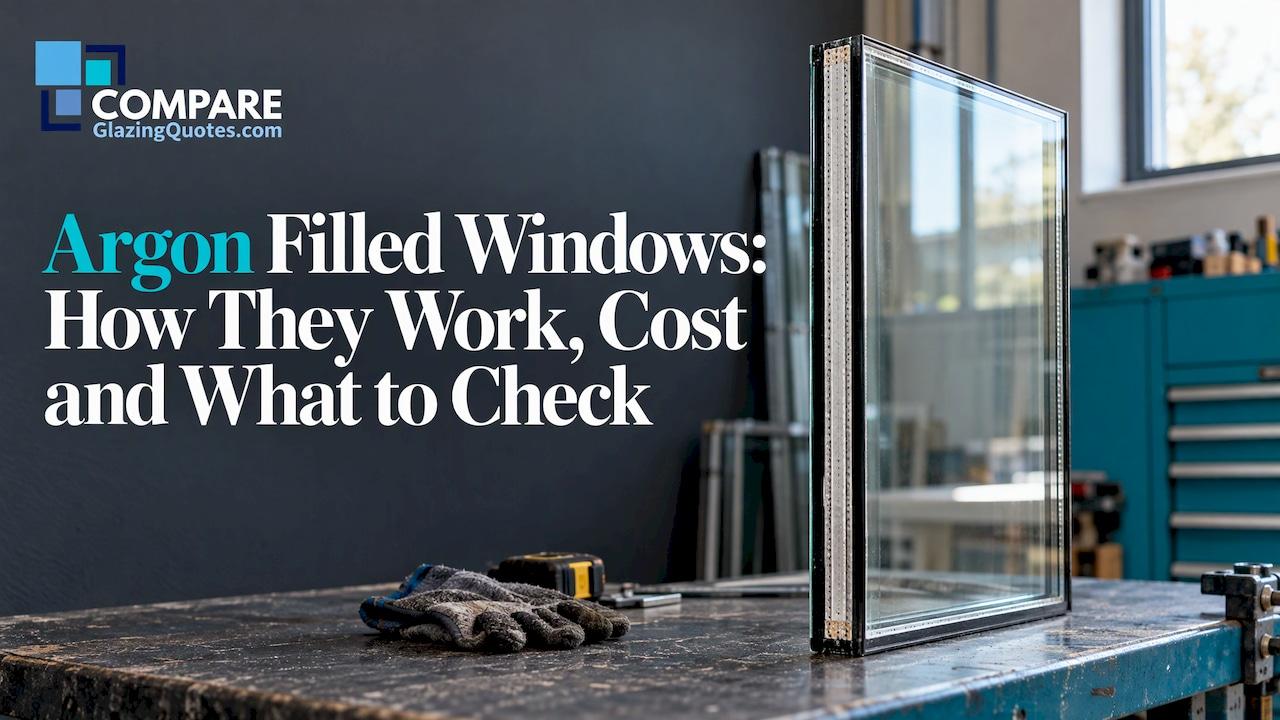
Argon filled windows are sealed double glazing units where the gap between the panes holds argon instead of ordinary air. Argon is denser and slower-moving, so less heat travels across the cavity and your rooms stay warmer for the same heating. It is odourless, non-toxic and sealed inside the unit for life, so you never handle it. What matters when you buy is whether each quote states the gas fill, the glass coating and the seal.
Below we explain the science plainly, put numbers on the saving, cover safety and lifespan, and list what to look for when quotes land on your doormat.
TL;DR
- Argon replaces the air between the panes to slow convection, which lowers the unit's U-value (heat loss) by roughly 0.2 to 0.3 W/m²K compared with air.
- It works best alongside a Low-E coating and a good edge seal, so check all three on every quote.
- Argon is safe in a sealed window. It is a natural, non-toxic gas that makes up about 1% of the atmosphere.
- Argon does little for noise. Choose glass thickness and laminated panes if sound is your priority.
- The gas is factory-sealed. If a unit fails (misting is the sign), the usual fix is a replacement sealed unit, not a top-up.
Table of Contents
- What argon actually does inside a window
- How much better is argon than air?
- Is argon in every window?
- Argon, krypton or air: which one suits your home?
- Is argon gas in windows safe?
- What argon does not do: noise
- How long does argon last, and what about the seal?
- How much does argon add to a quote?
- Our view on argon filled windows
- Get matched with local installers
- Making the most of your new glazing
- FAQ
- Sources
What argon actually does inside a window
A double glazed unit is two panes of glass with a thin cavity between them. Air in that cavity is not still. Warm air next to the inner pane rises, cooler air by the outer pane sinks, and this loop, called convection, carries heat out of your home.
Filling the cavity with a heavier, less mobile gas reduces that movement. Argon is the gas most commonly used, while krypton and xenon perform better but cost more. Argon is also easy to source: it is a by-product of the industrial liquefaction of air that produces oxygen, which helps explain why it is the standard choice rather than a premium extra.
The gas does not make the glass itself warmer by magic. It slows the transfer of heat across the gap, so the inside pane stays closer to room temperature. That means less chill near the window on a cold evening and less heat escaping through the glass.
How much better is argon than air?
The figures depend on the unit, but the direction is consistent.
- Swapping air for a 90% argon fill reduces the centre-pane U-value by approximately 0.2 to 0.3 W/m²K. U-value measures heat loss, so lower is better.
- A separate guide to glazing performance puts the improvement at 5 to 20% on the R-value of the glazing, R-value being the measure of resistance to heat flow.
- Gas fills help most when the gap is narrow. The same guide notes that argon makes a big difference where the gap is under the recommended 10 mm, such as older frames with 6 to 8 mm cavities.
In practice, a modern unit combines three things: two panes, a Low-E (low emissivity) coating that reflects heat back into the room, and the argon fill. Under Part L 2022, replacement glazing in existing homes in England has a maximum centre-pane U-value of 1.4 W/m²K, and the same source says a standard 4-16-4 unit with Low-E coating and argon typically reaches 1.2 to 1.4 W/m²K. Treat argon as one part of that package, not a stand-alone upgrade.
What it means for your energy bill
The Energy Saving Trust notes that the gap in a double glazed window is filled with air or an inert gas such as argon, which insulates even better than air. Its figure for upgrading an entirely single-glazed semi-detached home to A-rated double glazing is £85 a year in Great Britain and £140 in Northern Ireland, with a CO2 cut of 290kg a year in Great Britain and 550kg in Northern Ireland.

That saving relates to going from single to A-rated double glazing, not to argon alone. If your windows are already double glazed, the gain from replacing them depends on their age, condition and the performance of the new units.
Is argon in every window?
No. Gas filling is a specification choice. Some quotes state it, some assume it, and some budget units may use plain air. The only safe approach is to read the specification on each quote. Look for the words "argon filled" or "90% argon", or ask the installer to add them in writing.
A gas fill is also only one line of the spec. A clear way to compare is to set the key items side by side:
| What to check | Why it matters | What a good quote shows |
|---|---|---|
| Gas fill | Slows heat loss across the cavity | Argon stated, ideally with the fill percentage |
| Glass coating | Reflects heat back into the room | Low-E coating named on the inner pane |
| Unit U-value or energy rating | A single figure to compare like with like | Centre-pane or whole-window U-value, or an A rating |
| Edge seal and spacer | Keeps the gas in and moisture out | Spacer type and guarantee length |
| Frame and installation | Draughts and condensation often start here | Installer certification and installation guarantee |
Argon, krypton or air: which one suits your home?
For most UK homes, argon is the sensible default. It delivers a clear improvement over air at a reasonable cost, and it suits the standard cavity widths in modern units.
Krypton and xenon perform better but are more expensive. They tend to appear where a very thin cavity is needed, such as slim units in period properties, or in high-performance specifications. If you have a conservation-area home or a listed building, ask your installer what units suit the frames and what the local rules allow.
Our conservatory window replacement guide covers the signs a conservatory needs new glazing and what to ask for there. If you live in a flat, the guide to replacement windows for flats explains consent and costs before you request quotes.
Is argon gas in windows safe?
Yes. Argon is non-toxic, non-reactive, odourless and colourless, and about 1% of the Earth's atmosphere. It sits sealed between two panes, and a normal window never releases it into a room.
You may see warnings about argon and asphyxiation. These relate to bulk gas. The HSE says shielding gases such as argon can cause asphyxiation, usually through build-up in confined spaces, and gas suppliers describe argon as a non-flammable compressed gas that may cause asphyxiation in high concentrations. That is a workplace issue for welders and gas handlers. The few millilitres inside a window unit are nowhere near that scale, and if a pane breaks, the gas simply disperses into the room's air.
The practical safety point for a broken pane is the glass, not the gas. Keep children and pets away, wear gloves and sturdy shoes, and call a glazier.
What argon does not do: noise
Some people expect argon to quieten a busy road. It mostly will not. Argon-filled windows are effective for heat insulation but do not significantly block outside noise. If sound is a concern, tell the installer when you request quotes. Different glass thicknesses on each pane and laminated glass are the features usually specified for noise, and you can ask for those alongside the argon fill. That gives you both warmth and a calmer room.
How long does argon last, and what about the seal?
Argon is not consumed. It can only escape slowly through the edge seal. Well-made units lose very little.
- Window efficiency researchers put the leakage rate for an efficient window at about 0.5% of the gas fill per year, so after 20 years a unit would still perform at around 90% of its original capacity. That figure comes from a US consumer guide, so treat it as a guide to how sealed units behave rather than a UK guarantee.
- Overall, the Energy Saving Trust says double glazed windows can last 20 to 35 years if they are high quality, properly installed and well maintained, and well-installed double glazing can go beyond 35 years.
The seal matters more than the gas. When it fails, moisture gets in and you see misting between the panes. It pays to inspect your window seals periodically so gas loss is caught early.
Do not confuse the unit seal with the sealant around the frame. The perimeter sealant on the outside of the frame is a separate job that keeps draughts and water out, and a tidy approach to window caulking techniques helps the whole window last longer.
Can you refill argon in an existing window?
In everyday practice, no. Sealed units are filled in the factory and closed with a permanent edge seal. Once the seal has failed enough to lose gas, it has usually let moisture in too, so the sensible fix is a new sealed unit fitted into your existing frame, provided the frame is in good condition. A glazing installer can tell you whether the frame is worth keeping or whether the whole window should be replaced.
How much does argon add to a quote?
Homeowners often ask what the argon fill costs on its own. In most quotes you will not see it priced as a separate line, because it is part of the unit specification along with the Low-E coating and spacer. The price you should compare is the total for a like-for-like specification: same number of windows, same frame material, same glass, same gas fill, same guarantees.
The cost of a window project varies with the size of the openings, the frame material, the style, the number of windows and your region. Because of that, the useful approach is to collect several written quotes for the same specification and compare them line by line. A short checklist for each quote:
- Does it say argon filled, and is the fill stated as a percentage?
- Is a Low-E coating specified?
- What spacer type is used, and what guarantee covers the sealed units against misting?
- Is the unit's U-value or energy rating given?
- Is the installer certified, for example with FENSA or CERTASS, so the work is registered under Building Regulations?
- Are removal of old windows, making good and finishing included?
Quotes that omit the gas fill are not necessarily poor, but you cannot compare them with those that state it until you ask.
Our view on argon filled windows
We see the same pattern in the quotes homeowners compare: two prices that look far apart, with specifications that are not the same. One says argon and Low-E, the other says nothing. The gap in price can come down to the missing detail.
That is why we built Compare Glazing Quotes around side-by-side comparison. You tell us what you need, we match you with vetted local installers certified with FENSA and/or CERTASS, and you can compare quotes in one place rather than chasing several companies.
Our advice is simple. Decide on the specification first: argon fill, Low-E glass, a good spacer and a clear guarantee. Then ask every installer to quote to that. When the specifications match, the price comparison means something, and you can choose with confidence.
James
Get matched with local installers
If you are planning new windows, doors or a conservatory, our free comparison service takes the legwork out of it. You describe your project, we match you with local installers, and you compare quotes side by side. It is free and carries no obligation, and we say it can help you save up to £2,000 on an installation.

Tell us what you need on the Compare Glazing Quotes homepage, and ask each installer to state the gas fill, coating and guarantee so your quotes line up. We also cover areas such as Bristol, Greater London and Hampshire, and you can browse every area on our locations page.
Making the most of your new glazing
A few habits protect the performance you paid for.
- Check misting early. Condensation between the panes means the seal has failed. Note the window and contact your installer while the guarantee is running.
- Keep frame seals tidy. Cracked external sealant lets water and draughts in even when the units are fine.
- Keep trickle vents and ventilation working. Better-sealed windows hold in moisture from cooking and drying clothes, so ventilate to stop condensation forming on the inside.
- Keep your paperwork. Hold on to the quote, the specification, the guarantee and the installer's certificate. They matter if you need a repair or sell the house.
FAQ
Is argon used in all double glazing?
No. Argon is a common specification, but it is not automatic. Some units use air. Look at the quote or the unit's specification sheet, and ask the installer to confirm the gas fill in writing before you sign.
What are the disadvantages of argon gas in windows?
The main thing to know is that argon is about heat, not sound, so it does little for noise by itself. If a quieter room is your aim, ask for glass chosen for acoustics as well. Its long-term performance also depends on the edge seal, so a good guarantee on the sealed units is worth having.
Can I refill the argon in my windows?
Not in the usual sense. Sealed units are filled and closed at the factory. When a unit loses its seal, the practical fix is a replacement sealed unit, often fitted into the existing frame if it is sound. An installer can advise on your frames.
How long does argon last in a window?
It escapes only slowly through the edge seal. One consumer guide gives a leakage rate of about 0.5% a year for an efficient window, and the Energy Saving Trust says good double glazing can last 20 to 35 years or more. A strong seal and proper installation are what make that possible.
Sources
- Energy in buildings: Insulated windows, OpenLearn
- U-Value Calculator for Glazing, Clear Sealed Units
- Glazing and thermal performance in a building, Level
- Energy efficient windows and doors, Energy Saving Trust
- What is Argon Gas?, UKO Glass
- WL14 COSHH essentials for welding, hot work and allied processes, HSE
- Argon 4.8, Air Liquide UK
- Argon Gas in Windows: Benefits, Drawbacks and Energy, Solarscreen
- Gas Fills, NFRC Consumer Guide to Windows
- Expert Guide to Window Caulking Techniques